
Our Services
Comprehensive Age Management Model: 4 Levels of Systemic Support
At Diversity Hub, we approach the topic of age in organizations systemically. We define organizational challenges at

Level 1: Individual perspective – professional agency and combating age-related myths.
At this level, we focus on 2 dimensions concerning the personal perspective of your employees:
Strengthening professional agency
- Audit of developmental needs depending on life stage, not just age;
- Education and empowerment: webinars and workshops addressing fear of irrelevance and exclusion (among older employees) and lack of loyalty/sense of misalignment among younger employees.
Sample topics:
- “How to build a sense of professional self-worth at every stage of life”
- “Personal branding and lifelong learning – your value in the job market is ageless”
Age mythology and its impact on workplace functioning
- Building awareness and education: webinars and workshops focused on awareness of one’s own thought patterns, stereotypes, myths about different generations, as well as in the context of one’s own personal family experiences.
- Creation of educational materials building internal organizational know-how: one-pagers, e-learning, dedicated tools.
Sample topics:
- “Generation decoder – why is email a relic for some and a phone call stressful for others?”
- “50+ and 20+: debunking myths about laziness and digital exclusion”
- “What about these generations? Stereotypes and myths regarding generational diversity in the workplace”
- “What drives behaviors typical of specific age groups. On generational experiences, needs, expectations, values”
- “Gen Z, Gen Alpha, Silvers – what value they bring to the workplace and how to leverage their potential”
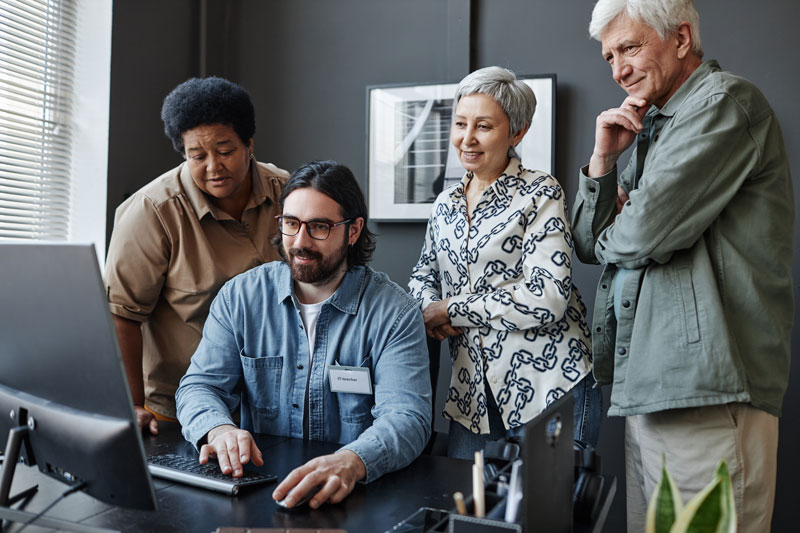
Level 2: Team synergy – effective communication and intergenerational collaboration.
At this level, we focus on achieving intergenerational synergy and address organizational challenges such as knowledge transfer, communication (including digital), intergenerational conflicts, and glass ceilings for young employees or pushing out older ones:
- Workshops on intergenerational communication and collaboration based on specific company work tools (not on Gen Z memes)
- Creation of educational materials building internal organizational know-how: one-pagers, e-learning, dedicated tools.
Sample topics:
- “Effective collaboration in a 4G team (4 generations)”
- “Conflict situations in intergenerational teams. How to derive value from age diversity?”
- “Same planet, different stories – culture and generational dialogue”
- “Intergenerational collaboration in teams: boundaries, expectations, feedback”
Level 3: Leaders: Inclusive Leadership – How to Manage an Age-Diverse Team?
At this level, we develop the competencies of team leaders to maximize the benefits of age diversity within their teams, particularly in responding to daily challenges arising from age differences. We also address the problem of a lack of competence authority among young leaders who have older individuals in their teams.
- Coaching for young leaders managing seniors
- Workshops for team leaders:
Sample topics:
- “From differences to opportunities – managing an age-diverse team”
- “Managing with authority, not hierarchy”
- “Young manager, older team – how to build authority regardless of age?”
- “Effective collaboration in a 4G team (4 generations)” – for leaders
- “How to engage employees from the youngest and oldest age groups?”
- “Resolving conflict situations in intergenerational teams”
- “Me as a leader – what I need to learn and unlearn when working with a generation younger than me”
- “Same planet, different stories – culture and generational dialogue” – for leaders
- “Inclusive intergenerational feedback – practical conversation scripts”
Level 4: Organizational strategy – succession, retention, and HR process audit.
At this level, we address the most critical challenges from the perspective of recruitment, development, and employee retention processes, systemic barriers for specific age groups, the specter of the silver tsunami, and knowledge management:
- Reverse mentoring programs, intergenerational tandem projects
- Audits: analysis of systemic age-related barriers (counteracting ageism and adultism), research into the needs of employees of different ages,
- Reviews of recruitment procedures and retention policies for experienced employees, etc.
- Support in building a conscious age management strategy, support in designing goals, developing action plans to achieve specific objectives
- Workshops and training
- Train the Trainer programs – preparing internal trainers in the area of age: understanding needs, designing development activities, language and communication tools, etc.
- Consulting and advisory services in HR processes counteracting ageism and adultism
- Support in internal and external communication regarding age-related topics
Sample workshop and training topics:
- “Demographic Resilience” – sessions for boards, senior management, HR, and DEI on demographic changes and their impact on the industry
- “Retirement tsunami – how not to lose the company’s operational brain in a short time?” – sessions for boards and HR
- “How to retain knowledge in the organization? How to ensure knowledge transfer and sharing?”
- “Recruitment beyond age – what to pay attention to, what to ensure?” – workshop for recruiters and HR
- “Designing reverse mentoring programs and other intergenerational development programs” – workshop for HR
Our approach to age diversity
Age diversity is a characteristic of almost every team. At Diversity Hub, we increasingly rarely encounter age-homogeneous teams; instead, people belonging to different generations work almost everywhere, often from the extremes – the oldest and the youngest.
Age-related challenges are therefore relevant today for every organization, without exception. For some, they will manifest as conflicts, lack of mutual understanding, ineffective communication and collaboration rooted in age differences. For others, ageism and adultism will represent specific business risks related to underutilizing the potential of certain age groups, loss of knowledge, turnover costs, etc.
In our work philosophy, we shift the focus from managing generations to managing values and shared goals, while respecting the specific needs arising from employees’ life stages. We move away from stereotypical perceptions of generations, avoid simplified categorizations that can be false and harmful, and recognize individuals instead of judging them through the lens of their birth date.
Instead of emphasizing differences – we focus on building bridges. Research indicates (e.g., the “Beyond Age” Report) that age ranks only sixth among factors influencing good collaboration. In our work, we demonstrate that employees have more in common than they think, and that trust is a significant factor in the age dimension, particularly important for the youngest and two oldest age groups. Therefore, our initiatives always include creating conditions and collaboration rituals that allow younger employees to bring fresh perspectives and older employees to share their experience, as well as creating an environment that supports continuous learning, which does not exclude older employees but is based on their genuine openness to change.